Why Lion’s Roar Keeps Coming Back in My Work
People keep asking me why lions return so often in my work.
The simple answer is that they never really left.

The lion has become one of my most recurring characters because it gives me a way to talk about emotion without becoming heavy-handed about it. I am interested in animals as emotional avatars. They let me speak about tension, pride, vulnerability, release, stubbornness, calm, and absurdity all at once. A lion can hold all of that. It can look noble one second, ridiculous the next, and somehow still feel true.

The lion keeps returning because it still gives me room to say something real.

For me, the lion did not begin as an abstract symbol. It began somewhere more personal.
My grandfather loved going to the Kruger National Park whenever he could, and lions were his favourite animal. One of his favourite things to do with us as children was to make a powerful growling sound. Looking back, I think that was his way of connecting with us. Later, when I started working on lions, that memory came back before any reference image did.
The tongue-out gesture also connected with something else in my life: the yoga posture called Lion’s Breath. You open the mouth, stick out the tongue, and exhale forcefully. It looks ridiculous, but it works. It is a posture about release.
That is important to me because the tongue in these sculptures is not about aggression. It is about letting go. It is about breath, tension leaving the body, and returning to the present. The project notes describe this clearly: the tongue-out gesture is not threat, it is release.

Use an image where the tongue is clearly visible.
Over time, the lion stopped being just one sculpture and became a full character world.
That is how I think about it now. Not as one successful shape repeated over and over, but as a character that keeps evolving. The same spirit can move across materials, sizes, moods, and settings while still remaining recognisable.
In one form it becomes a monumental mirror-polished stainless steel sculpture. In another, it becomes a small crystal edition. In another, it becomes a pair of guardian lions in granite or black marble. In another, the motion of the mane breaks apart into wall-mounted forms like freeze-frames of emotion.
The lion now moves across stainless steel, crystal, granite, black marble, and wall-mounted polka dot forms. The project description explicitly describes the series as a “full character world” rather than a single sculpture.
Material changes the emotional temperature of the lion every time.

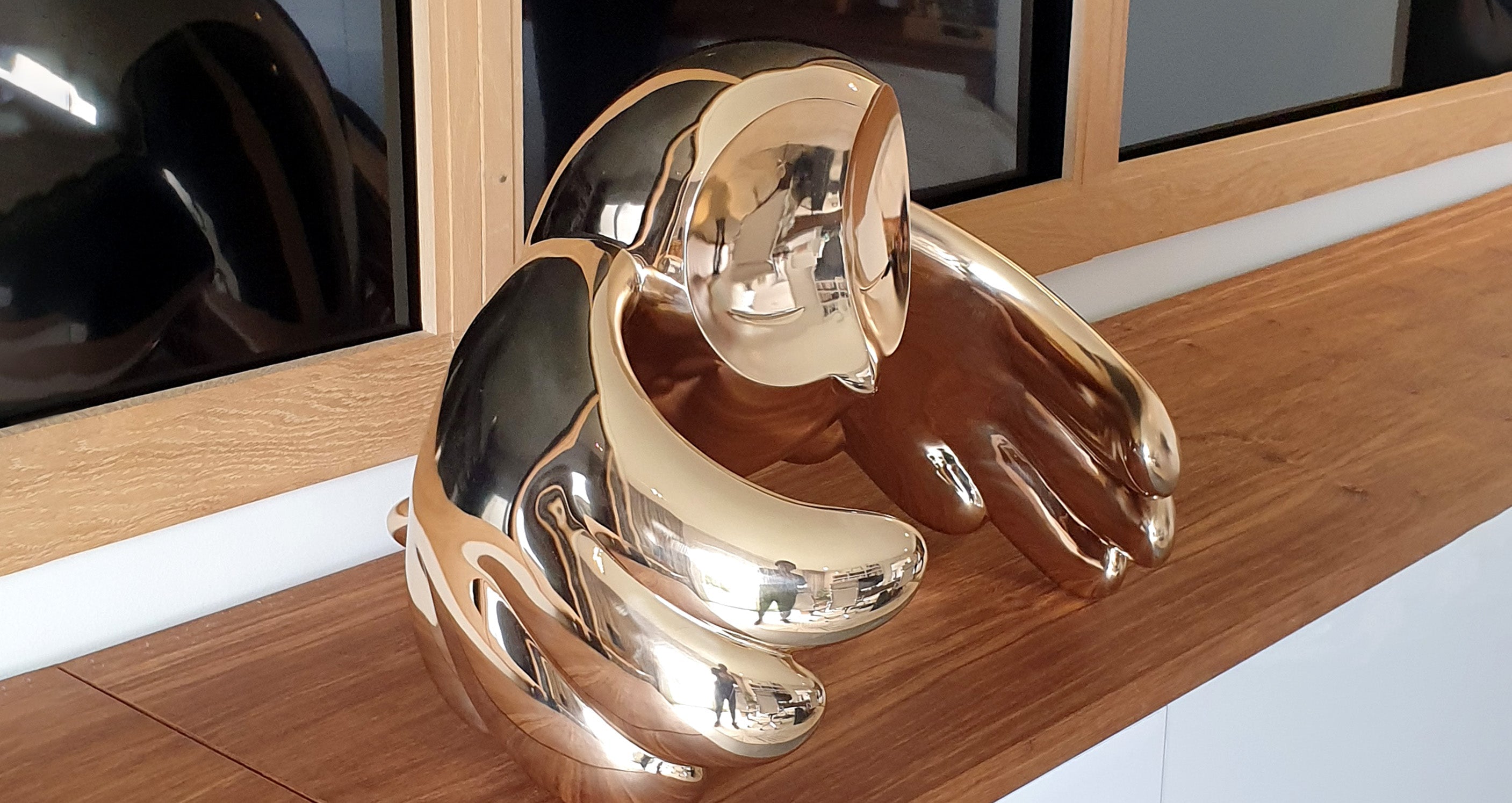
In mirror-polished stainless steel, the lion becomes highly present, reflective, and almost impossible to ignore. The surface pulls the room into the work, so the sculpture does not just sit in space, it captures its surroundings. In crystal, the lion becomes lighter, stranger, and more playful. Colour changes everything. Pink feels different from amber. Grey-black feels different again. The same character starts behaving differently depending on transparency, colour, and light.

The stone versions do something else altogether. Granite gives the work a grounded, durable, architectural presence. Black marble pushes it toward something darker and more formal.

The series includes stainless steel works in both large and medium scales, crystal editions in multiple colours, and Foo Lion Roar editions in both granite and black marble.
If there is one version that feels most iconic to me, it is the polished stainless steel lion.

It has scale, clarity, humour, and presence all at once. It reflects the room and the viewer, which makes the sculpture feel less closed off and more alive. The large Lion’s Breath was produced in polished stainless steel, with a large editioned version at 125 cm and a smaller version at 60 cm.

This reflective material also suits the lion concept well. The work is already about emotion, breath, and presence, and stainless steel intensifies all of that.
The lion did not stay only in three-dimensional form.
One part of the series expands into wall-mounted polka dot works based on the motion of the lion’s mane and expression. I like these pieces because they feel like repeated emotional beats, almost like the lion’s release has been broken into rhythm, colour, and sequence.
In the project material, these are described as freeze frames of the lion’s motion, with five shape variations and thirteen colours, resulting in sixty-five unique pieces.
 The lion works have continued to evolve through exhibitions.
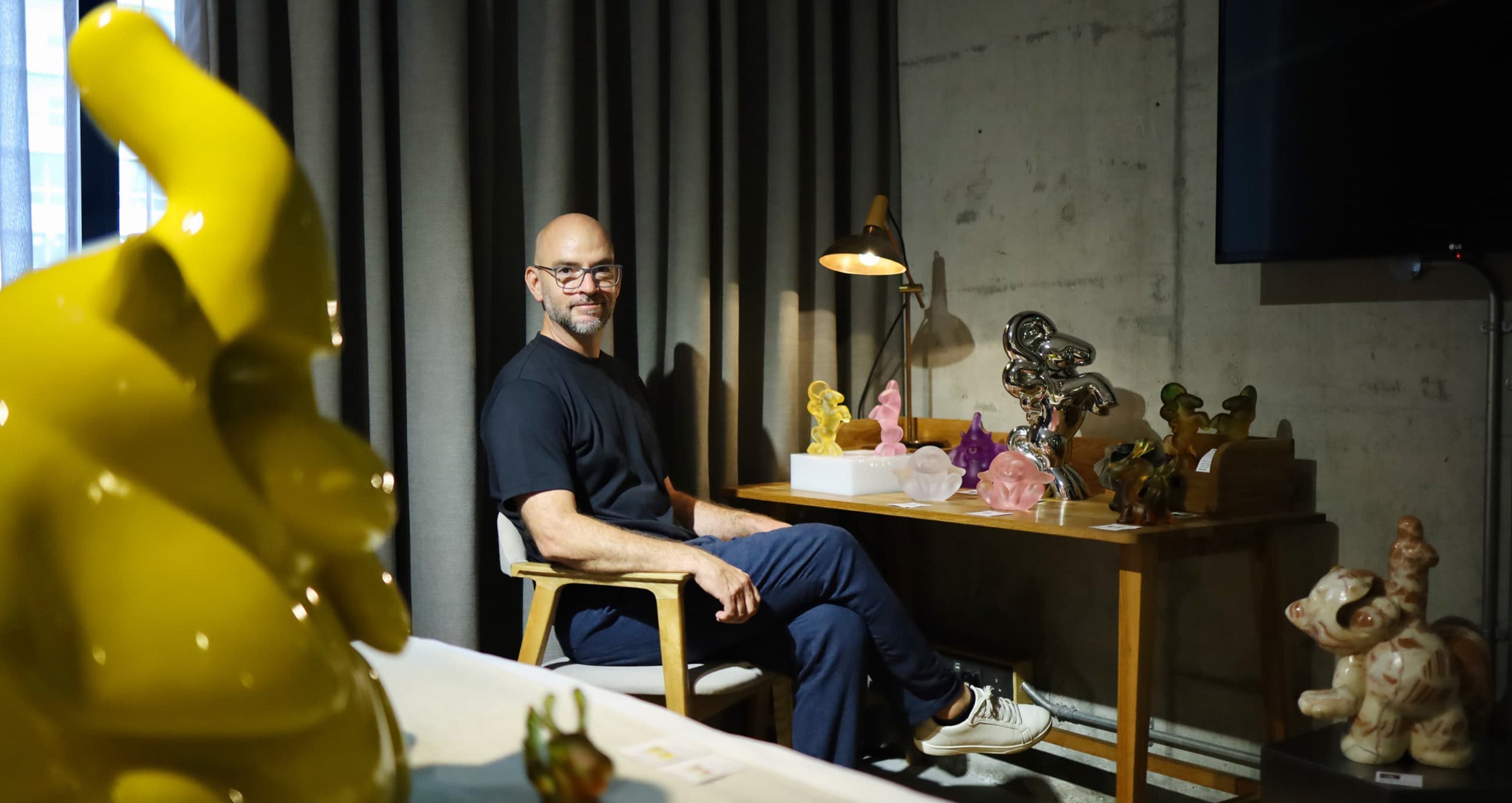
That matters to me because exhibitions let the character breathe differently. A single lion on a pedestal has one kind of presence. A lion placed in dialogue with wall works, crystal editions, other characters, or a full installation creates something broader. It becomes an environment rather than an isolated object.
This body of work has grown through exhibitions, product editions, and new interpretations of the same core character. That evolution can be seen across the Lion’s Breath project presentation and the later Lion Roar and Foo Lion Roar works.

I also like that the lion can carry its own making process visibly.
These works move through sketching, modelling, scaling, fabrication, carving, polishing, casting, and finishing. That matters because I do not want the lion to feel like a slick repeated object. I want it to feel developed, tested, translated, and worked through.
Seeing the unfinished form beside the polished stainless steel version makes that very clear. The lion is not static. It evolves through material and production until it becomes fully itself.


The guardian lion versions take the series in another direction.
With Foo Lion Roar, I am drawing from the long history of guardian lions and pulling that language into my own sculptural world. These works let me connect the lion with protection, architecture, and place, while still keeping the humour and softness that I care about.

I like the tension there. A guardian figure does not need to become stiff or solemn. It can still have personality. It can still feel playful while holding presence.
The Foo Lion Roar editions were produced in both granite and black marble, each as paired works.

The crystal lions are where the character becomes lighter, weirder, and in some ways more intimate.
Scale changes the relationship completely. These smaller works are closer to the body, closer to domestic space, and colour begins to change the mood very directly. Amber carries warmth. Pink becomes softer and more playful. Grey-black feels moodier and more restrained. Mix colour pushes the lion toward something more vivid and unstable.

When I look at the lion works together, what interests me most is not repetition for its own sake. It is the chance to keep testing how one character can transform while carrying the same emotional core.
The lion can be monumental or intimate. Reflective or matte. Luxurious or ridiculous. Architectural or playful. That range is useful to me because emotion itself is not neat. It shifts. It loops back. It comes out differently depending on the day, the room, the material, or the person standing in front of it.
That is probably the real answer.
The lion keeps coming back because it still has more to say.